Test what you’ve learned in a practice shop.
The field test is a practice shop with seven dark patterns and one honest feature. Flag what you notice, then check your answers. Nothing you do is recorded.
The offer is a free week or a first box for a dollar, and accepting it also commits you to paying every week or month after that.
It is Brignull’s (2010) “forced continuity” and the “hidden subscription” of Mathur et al. (2019), and policymakers call it a “subscription trap”.
What it costs you
Payments you didn’t plan for, often for weeks or months before you notice them.
Specimen
Your first box for $1
6 chef-designed meals · Free delivery · Skip anytime
Then $69.99/week until cancelled. Cancel by 11:59pm the day before your next box ships to avoid charges. See Terms.
Almost there
Your $1 box arrives Thursday!
Get ready for six meals and zero planning. We’ll send recipes to [email protected].
Before you skip ahead a month: how much do you expect to have paid Fork & Field by then?
Your card statement · Visa •••• 4417
Emails from Fork & Field this month
4 recipe newsletters · 0 renewal reminders
Your first box for $1
6 chef-designed meals · Free delivery · Skip anytime
1Then $69.99/week until cancelled. Cancel by 11:59pm the day before your next box ships to avoid charges. See Terms.
3Before your first $69.99 charge
You get no email or notification.
4$1 today, then $69.99 a week
A weekly plan: 6 meals a box. Your first full charge is on 16 October. Cancel in one click, any time before a box ships.
Your plan has started.
You paid $1 today. Your first full charge, $69.99, is on 16 October. We’ll email you on 13 October with a link to cancel.
One box, ordered.
You paid $74.99. There’s nothing to cancel.
A small first payment can hide a larger one behind it. The pattern appears wherever a trial or an introductory price can roll over by itself.
Before you reveal each answer, decide which of the six attributes the example relies on.
Seven days free. A card is required to start, and the trial becomes a paid plan on day eight.
Asking for a card for a free trial is what makes the rollover possible. The renewal price sits below the button.
An app offers a short free trial. What follows is billed annually, all at once.
The trial is measured in days and the commitment in years, and the annual price is the smallest line on the sheet.
A newspaper offers its first three months for $1.99 a month.
The rate after three months is twelve times higher, and it applies automatically.
A “free” bottle costs only $4.95 to post. Ticking the box at checkout joins a monthly delivery.
This is the record-club model moved online. The free item gets you in, and the repeat delivery is what the company is really selling.
The offer is usually accurate about the first payment. What it obscures is everything afterwards, including the renewal, the price it renews at, and the fact that doing nothing counts as agreeing.
Mathur et al. (2019) found this “hidden subscription” on 13 shopping sites in their crawl. One wine club sold an $89 service that appeared to be a one-off payment and quietly renewed every year. They note that it often appears together with hard to cancel, so the commitment is easy to enter without noticing and hard to leave once you do.
It works because people are confident they’ll cancel in time. In Luguri and Strahilevitz’s (2021) experiments, the monthly price of a plan offered after a free trial barely changed how many people accepted it. At $8.99 or $38.99, roughly the same share signed up, and around three-quarters of those who accepted thought they would probably cancel before paying. Putting the terms in smaller, less prominent print roughly doubled acceptance compared with a plain offer.
Mathur et al. (2021) classify the pattern as deceptive and information hiding, because it misrepresents the nature of the offer and withholds the recurring cost until after you have agreed to it.
Mail-order record and book clubs led with a generous introductory offer and put the commitment in the small print. Members agreed to buy a set number of further titles at full price, and to accept each month’s selection unless they sent a card back in time.
The model depended on the gap between what the coupon advertised and what it bound you to. When the US Federal Trade Commission adopted its Negative Option Rule in 1973, its first demand was disclosure, so that the terms of the commitment had to be stated clearly before anyone signed up.
Read the chapter: Mail, credit & the negative option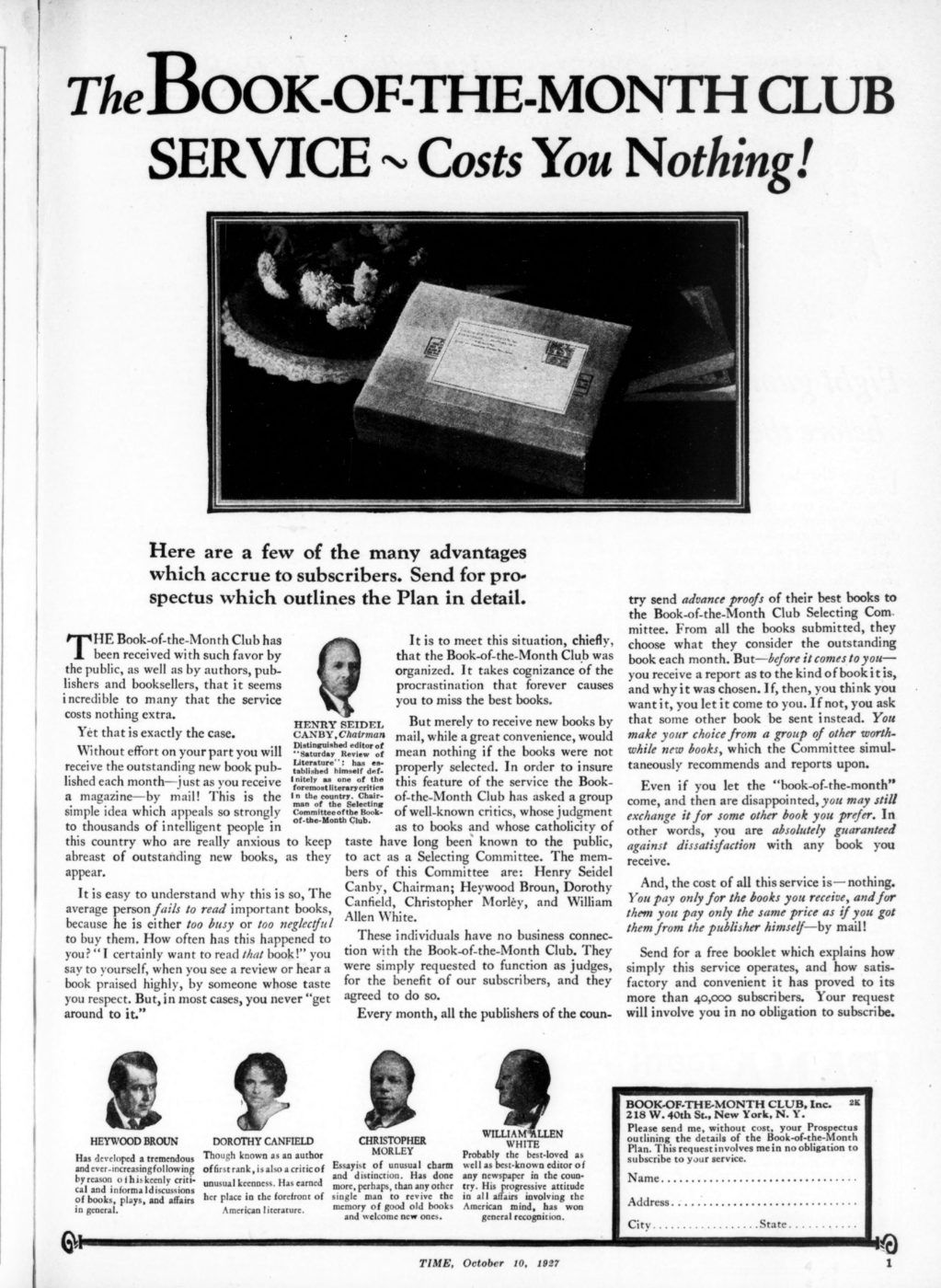
Show the full price at the same size as the offer, name the plan on the button, and send a reminder before the first full charge.
Activity
Find an example
Look for this pattern in an app or website you used this week. Note the date, what you saw, which of the six attributes it relies on and how you would make it honest. If it’s a clear example, send it to us.
Last reviewed October 2026. A summary, not legal advice.
Hidden commitments. (2026). In Deceptive by Design: A history and field guide to manipulative interfaces. https://deceptivebydesign.org/patterns/hidden-commitments/
Test what you’ve learned in a practice shop.
The field test is a practice shop with seven dark patterns and one honest feature. Flag what you notice, then check your answers. Nothing you do is recorded.